Why a Good MT5 Backtest Dies Live: Spread, Slippage and Execution
Zero latency, calm spreads, and zero slippage make fragile EAs look unbeatable. Here are the five live costs MT5 misses by default and a 3-run stress test.
The MetaTrader 5 Strategy Tester is an accurate simulator of a market that does not exist. Understanding why MT5 backtest fails live starts with looking at its default assumptions: zero network latency, instant fills at quoted tick prices, zero slippage on stop orders, zero commission unless your account archive supplies it, and calm spreads unless real-tick spread spikes happen to cover your test window.
At 10:00 on a quiet Tuesday on H1, that idealized environment sits reasonably close to live execution. At 15:30 server time during US inflation data or right at daily rollover, it looks nothing like a live broker book — which is the exact minute many scalping and breakout EAs try to fire.
On this page6 sections
The Five Execution Costs, and Which Strategies Break First
| Execution cost | Default in Strategy Tester | Live account reality | Most exposed strategy types |
|---|---|---|---|
| Spread expansion | Fixed typed value, or archived spread where real ticks exist | Widens 3×–10× at rollover, thin Asian open, and macro news releases | M1/M5 scalpers, night scalpers, and EAs with tight stop-losses |
| Round-turn commission | 0.00 unless raw-account symbol rules apply it |
Charged per lot on every entry/exit regardless of win or loss | High-turnover EAs whose expected payoff is only a few points per trade |
| Order-book slippage | Not realistically simulated on historical tick files | Asymmetric negative fills on stop-losses and breakout buy/sell stops | News-breakout bots, tight trailing-stop EAs, and momentum scalpers |
| Latency & requotes | Zero latency instant execution by default |
VPS-to-server milliseconds, order-queue delays, and freeze-level rejections | Tick-trigger scalpers chasing sub-second impulses |
| Overnight swap / financing | Uses current symbol swap spec (often ignored in synthetic setups) | Charged nightly with triple-swap Wednesdays on leveraged baskets | Multi-day grids, averaging bots, and carry-negative trend holders |
Notice where all five frictions concentrate: high-frequency M1/M5 scalpers, tight-stop breakout bots, and multi-level grids. Those three categories dominate retail EA marketplaces because they produce the steepest zero-latency backtest curves — and suffer the steepest live mortality rate once real execution friction arrives.
How Published Runs on AlgoToolbox Handle Those Limits
Saying “backtests do not validate live trading” only helps readers if each report states the exact cost assumptions used:
- Explicit zero-latency disclosure: baseline Strategy Tester runs on Gold Beaver MT5 and our other third-party reviews state
zero latencydirectly in the Test Bench rather than implying VPS-grade live execution. - Modelled spread vs stress test: our Scalping Robot Pro MT5 check ran with a modelled 2-point spread on
Exness Raw Spread (MT5Real7)— and flagged plainly that a fixed 2-point assumption plus discarded real-tick minutes is a baseline simulation, not live-cost proof. - Spread filters vs missed exits: 15M Gold Scalper enforces a
MaxSpreadcap of300points on entries. Entry spread caps block bad new trades during spread spikes, but they cannot stop an already-open stop-loss from triggering when the ask line widens across your stop at rollover. - Unsimulatable slippage & flat regimes: our Ghost Scalper MT5 review notes both that real broker slippage cannot be faithfully simulated in the tester (a limit the developer’s own listing acknowledges) and that even without slippage, the equity curve stayed flat for nine straight months.
The Three-Run Spread & Cost Stress Protocol
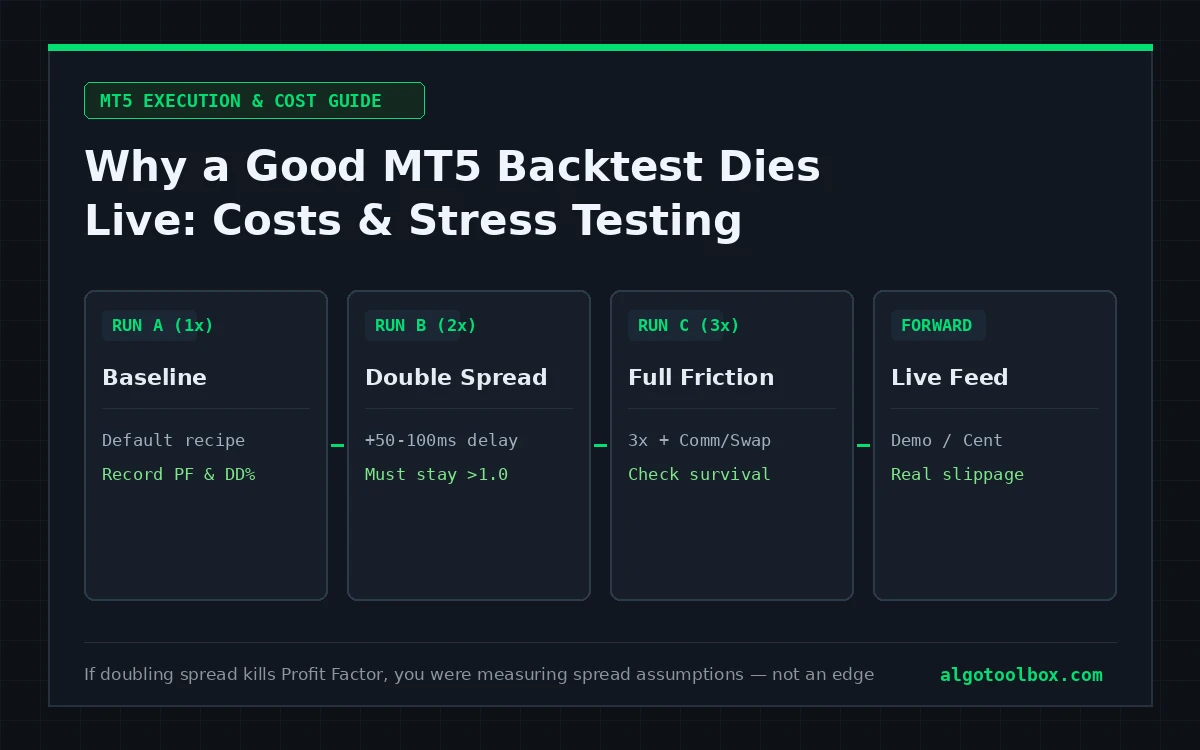
Before putting even a demo VPS behind a commercial or open-source EA, run three backtests over the same recent real-tick window using its free demo or compiled build:
- Run A — Baseline recipe: use the developer’s default inputs (or published
.setfile), your target account type’s typical spread/commission, and zero latency. Record Total Trades, Profit Factor, Expected Payoff, and Equity Drawdown Relative. - Run B — 2× spread + realistic latency: double the fixed spread (or add spread padding on a custom symbol) and switch Strategy Tester Delays from Zero latency to
50–100 ms(or Random delay). Record the same four metrics. - Run C — 3× spread + full round-turn commission & swap: triple the baseline spread with verified raw commission and overnight swaps active. Record the same four metrics.
Evaluate how the EA degrades across the three passes:
- If Profit Factor drops below
1.00at 2× spread: you are looking at a spread-sensitive scalper whose entire paper edge sits inside one or two points of optimistic fill pricing. - If Total Trades drops by 80% at 2× spread: the EA’s internal spread filter is sitting right next to your broker’s normal spread, meaning live execution will either starve for trades or only fire during unusually quiet hours.
- If Profit Factor eases gradually (say
1.75 → 1.42 → 1.18) while trade count and curve shape hold together: the underlying signal has real breathing room above transaction friction.
What the Strategy Tester Genuinely Cannot Reproduce
Even a disciplined three-run stress test leaves three structural blind spots:
- Liquidity-dependent slippage: historical tick files record top-of-book quotes, not available depth at that price or where a 2-lot stop order actually clears during Non-Farm Payrolls.
- Broker rejections, off-quotes, and freeze levels: live servers reject or delay stop modifications inside volatile spikes in ways local tester agents do not emulate.
- Live server-to-server feed differences: two brokers quoting
XAUUSDat the exact same second often differ by several points on spike highs and rollover lows, triggering stops on one terminal while leaving the other untouched.
Use Strategy Tester stress runs to eliminate fragile EAs quickly on paper — then validate survivors on a small forward demo or cent account on the exact broker server, account type, and VPS latency you actually intend to trade.
Where to Go Next
- How to Read an MT5 Strategy Tester Report, Line by Line — how to check Expected Payoff against per-trade spread and commission
- MT5 Modeling Quality Explained — why M1 OHLC and generated ticks mask intrabar stop-outs
- Absolute vs Relative Drawdown in MT5 — how wider spreads amplify floating equity drawdown
- How We Test — how our Test Reports separate Strategy Tester simulations from live trading claims
FAQ
What is the main reason why MT5 backtest fails live within the first month?
In order of frequency: unmodelled round-turn commissions on high-frequency scalpers, optimistic fixed spreads that miss rollover/news widening, negative stop-order slippage on fast breakouts, and curve-fitted parameters tuned to past price history.
What spread setting should I use when stress-testing an EA in MT5?
Run your baseline on the real variable spread of your target broker account (or its realistic daytime average), then run 2× and 3× fixed-spread passes alongside 50–100 ms execution delay. If doubling the spread flips the curve negative, live volatility will do the same.
Can the MT5 Strategy Tester simulate live broker slippage accurately?
No. While MT5’s Delays dropdown lets you test execution lag by filling orders on ticks arriving 50 to 500 milliseconds later, historical tick files still lack order-book depth, liquidity gaps, and broker-specific requote or stop-fill rules.
Does an EA’s “Max Spread” input protect me completely from rollover spread spikes?
Only on new entries checked inside the EA’s code. Broker-side stop-loss orders resting on open buy positions trigger on the live Ask price, so a sudden midnight spread blowout can still stop out an existing trade even when new entries are blocked.
How long should I forward-test an EA after it survives spread stress tests?
Long enough to observe at least one major macro news cycle, daily rollover behaviour, and an uncomfortable losing or flat stretch on your exact target account type — typically several weeks to a few months depending on trade frequency.
Risk & Transparency Notice: All indicators, scripts, and backtest results on AlgoToolbox are for educational and testing purposes only. Trading Forex, CFDs, and cryptocurrencies carries significant financial risk. Past performance does not guarantee future results. Read our full Risk Disclaimer.