My AI Gold MT5 Review
My AI Gold v1.82 backtested on XAUUSD H1 with three developer sets: steady on Conservative, but $40 stops vs $25 targets and a 92% Aggressive drawdown.
This My AI Gold MT5 review tests Vitalii Kosov’s $799.95 gold Expert Advisor with three of the developer’s own set files in the Strategy Tester. The EA trades XAUUSD on H1, holds one or two positions at a time, and gives every entry a fixed stop-loss and take-profit. Position size grows with the account balance.
We ran version 1.82 from the Market demo on a raw-spread account from December 2020 to October 2026, using the Conservative, Prop (FTMO) and Aggressive sets. The Conservative set ended with a 1.76 profit factor and an 11.37% maximum equity drawdown. In every trade, however, the stop-loss was wider than the take-profit, and the Aggressive set fell 92.76% at one point.
Test Bench
| Specification | Our configuration |
|---|---|
| Platform | MetaTrader 5 |
| Tool type | Expert Advisor |
| Version tested | 1.82 |
| Symbol / timeframe | XAUUSD H1 |
| Test period | 2020.12.03 – 2026.10.21 |
| Data / tick mode | Every tick based on real ticks (history quality 4–7% real ticks) |
| Account & spread | Exness Raw Spread (MT5Real7), variable spread, $0.04 commission per 0.01 lot, $2,000 deposit, 1:500 |
| Copy tested | Free demo (MQL5 Market), Strategy Tester |
What My AI Gold Is and What the Listing Promises
My AI Gold is a fully automated Expert Advisor for gold. The official MQL5 Market listing describes it as built on custom neural networks. It recommends XAUUSD on the H1 chart, yet also says the EA can be attached to any timeframe. The user picks a risk profile, and the listing ties each profile to a deposit size: at least $1,000 for normal risk, at least $2,000 for low risk, and $500 or less already counts as high risk.
The listing makes several specific claims. It says the EA uses no martingale, no grid and no averaging, and that every trade is protected by a stop-loss and a take-profit. It also describes a “solid 1:2 risk-to-reward ratio”, calls the EA “prop firm ready” for FTMO-style challenges, and calls it “broker independent”, not sensitive to execution speed or spreads. It still recommends raw-spread or ECN accounts. Finally, it cites a “+1000%” live track record and a $10,000 IC Markets account.
On 25 October 2026 the price was $799.95, or $499.95 for a one-year rental. The EA was published on 4 September 2026 and has had seven updates since. We tested version 1.82 (21 October 2026), the current release. That update adds a dedicated Prop Firm preset and a user-set limit on open trades, and its notes say the trading logic itself did not change.
How It Trades in the Tester
We cannot see the neural network the listing describes, so this section covers only what the EA did in the tester and what the order and deal lists record. All three runs traded the same signals; the sets differ mainly in position size, and the Prop set also allows only one open trade. The Conservative run opened 1,023 positions in just under six years, about 3.3 a week.
Entry
The EA enters with market orders, never pending orders, and holds at most two positions at a time (one with the Prop set). Entries cluster in two blocks, overnight from 01:00 to 09:00 and from 12:00 to 20:00 server time. There was just one new trade in the 10:00 hour and none in the 11:00 hour. The trading window comes from the BeginHour and EndHour inputs, with AutoGMT adjusting them to the broker’s time zone.
Exit
Every one of the 1,023 entries carried a stop-loss and a take-profit from the first second. Their distances barely varied: the stop sat about $40.00 from entry and the target about $25.00 in every case. A trailing stop starts once a trade is $16 in profit, so only 15 trades ever reached the take-profit. Most winners were closed by the trailing stop: 766 exits carry the “sl” tag, which covers both full stops and trailed stops. In addition, 242 positions were closed by the EA on Fridays at 20:00 server time, before the weekend.
Position management
We saw no grid, no averaging and no martingale. Lot size follows the balance: the Conservative set started at 0.01 lots on $2,000 and ended at 0.08 lots on about $15,800. That works out to roughly 1.8% of the balance at risk per trade if the $40 stop is hit, and the size never stepped up right after a loss. The Recovery option, which keeps the lot size unchanged after a loss instead of shrinking it with the balance, was off in all three sets.
Our Test Setup
| Input | Default (developer sets) | Our value | Why |
|---|---|---|---|
| Risk preset (riskk) | Differs per set | Conservative 6 · Prop 7 · Aggressive 1 | Three of the developer’s published risk levels |
| Max open trades | 2 (Prop set: 1) | Unchanged | The Prop set limits exposure to one trade |
| Take-profit / stop (TKProfit / RST) | 250 / 400 | Unchanged | Measured as $25 / $40 from entry on gold |
| Trailing (TrailStart / TrailStep) | On, 160 / 5 | Unchanged | Trailing starts at $16 profit, moving in $0.50 steps |
| Trading window | 15:00–11:00, AutoGMT on | Unchanged | The developer’s session filter |
| Friday / Wednesday close | Friday on, Wednesday off | Unchanged | Positions close before the weekend; triple swap is paid |
| Recovery | Off | Unchanged | The lot follows the balance after losses |
| News filter | Off | Unchanged | Left as the developer’s sets ship it |
Disclosure: the broker link below is an affiliate link; AlgoToolbox may earn a commission at no cost to you. It does not affect our test results.
We changed nothing inside the three set files. Each run used the Exness-MT5Real7 server (terminal build 6230) on an Exness raw-spread account. Settings were a $2,000 deposit, 1:500 leverage, XAUUSD H1 and “Every tick based on real ticks”, with a commission of $0.04 per 0.01 lot.
We set the start date to 1 January 2016, but the server’s gold history begins in early December 2020, so the first trade came on 3 December 2020. History quality was only 4% to 7% real ticks; the rest were generated ticks. Our bench rules are on the how we test page.
Backtest Results: Reading the Data
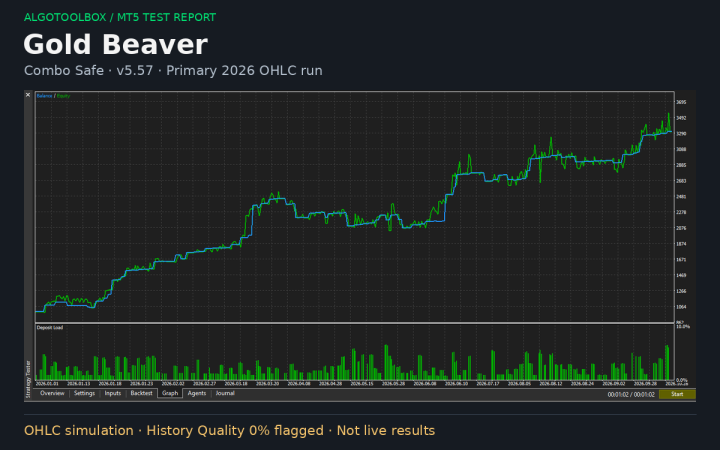
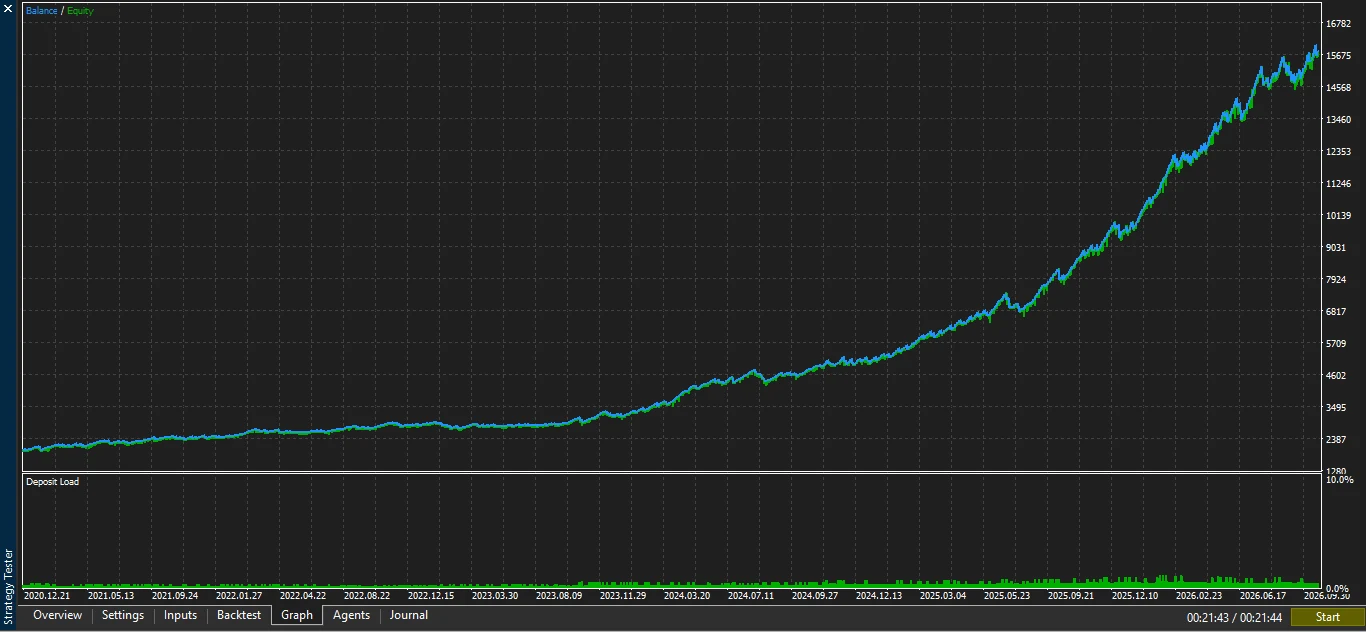
The Conservative run (Run 1) grew $2,000 to $15,793.38. Growth was slow and steady from 2021 to 2023, then much steeper from 2024 onward, which is partly compounding: the lot size grows with the balance, and gold’s larger dollar moves raise the value of each trade. Every full calendar year was profitable. The weakest was 2023 at +10.4% (profit factor 1.36), and the strongest was 2025 at +92.0% (profit factor 2.00).
The curve is smooth, but not without setbacks. In fact, 19 of the 71 months lost money; the worst was July 2025 at −$461.40. The balance went 272 days without a new high, from 13 January to 12 October 2023. The largest percentage drop in equity was 11.37% ($853.60), and the largest dollar drop was $1,129.08 (7.21% of the balance at that time).
| Metric | Result | Source | What It Tells You |
|---|---|---|---|
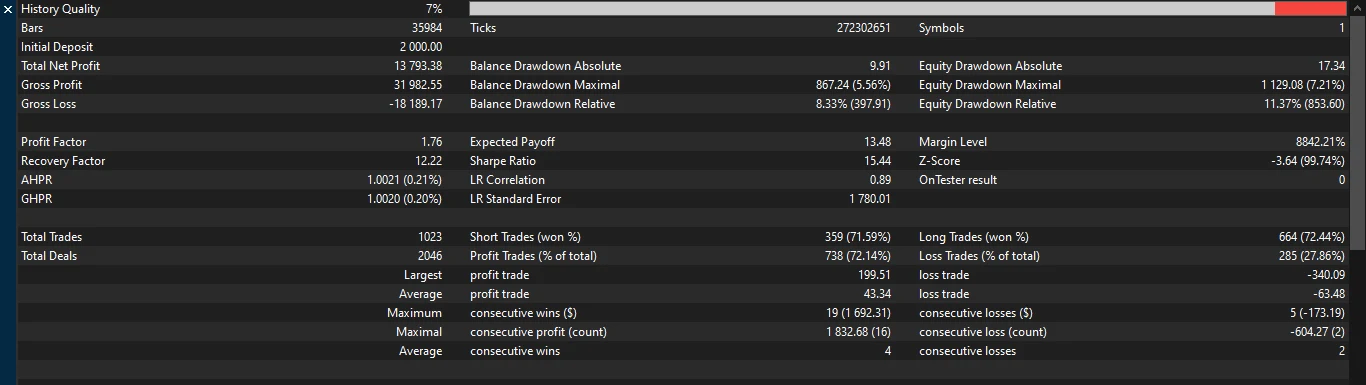
| Total net profit | $13,793.38 on $2,000 | Run 1 report (Figure 3) | A 690% gain with compounding at about 1.8% risk per trade |
| Profit factor | 1.76 | Run 1 report (Figure 3) | Gross profit of $31,982.55 against a gross loss of $18,189.17 |
| Trades and win rate | 1,023 trades, 72.14% won | Run 1 report (Figure 3) | About 3.3 trades a week; longs and shorts both won about 72% |
| Average win / loss | $43.34 / −$63.48 | Run 1 report (Figure 3) | The average loss is 1.46× the average win, so the edge depends on the win rate |
| Max equity drawdown | 11.37% ($853.60) | Run 1 report (Figure 3) | The deepest percentage dip of the run |
| Trading costs | $98.09 commission, $796.58 swap | Run 1 deal list | Overnight swap costs far more than commission, because trades last about 27 hours |
| Prop (FTMO) set | $4,209.11, PF 1.66, 7.68% max equity DD | Run 2 report | One trade at a time and about 1.5% risk; worst closed day −1.92% |
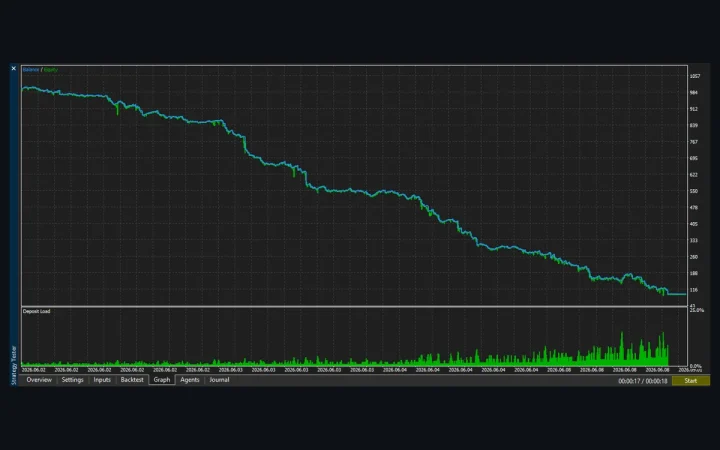
| Aggressive set | 92.76% max equity DD | Run 3 report (Figure 5) | About 26% of the balance at risk per trade; the account nearly emptied in 2023 |
Robustness Checks
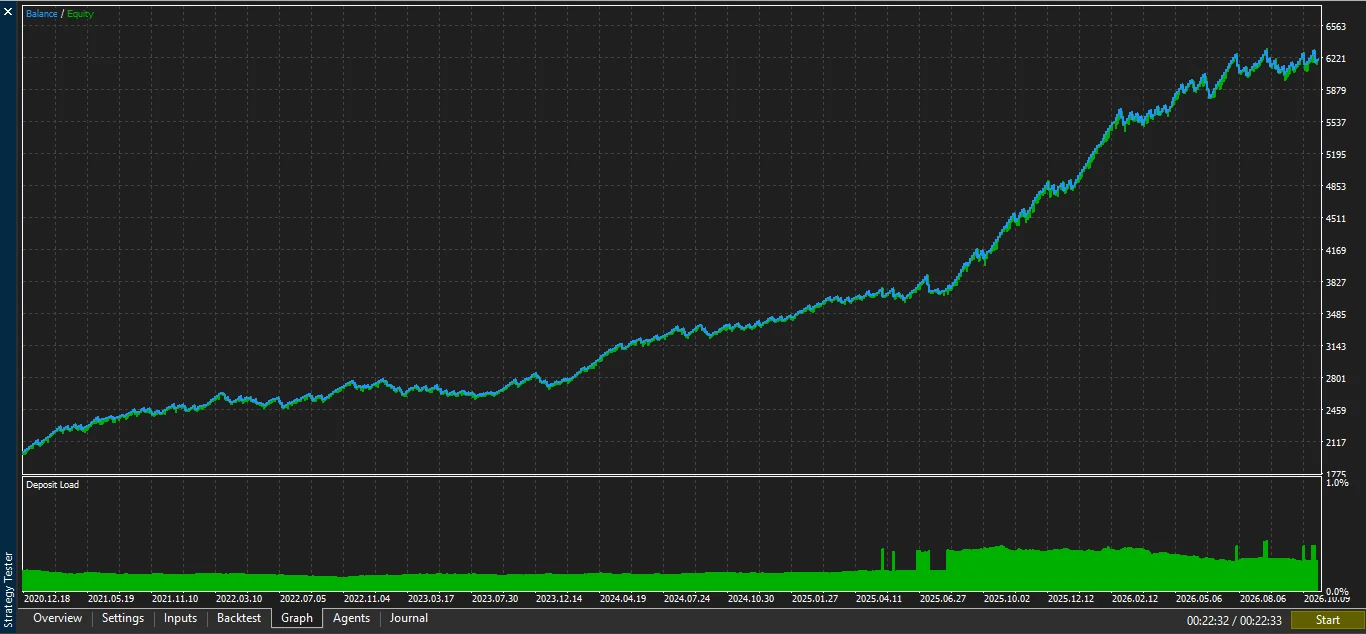
The Prop (FTMO) set (Run 2) works as a partial robustness check, because it trades the same signals with one position at a time and smaller size. It made a profit in every calendar year as well, although 2023 was almost flat at +0.8%. Its deepest equity dip was 7.68% ($215.04), and its worst closed day lost 1.92% of the balance. The longest stretch without a new high was 307 days.
The tested period mostly predates the release. Version 1.51 (24 September 2026) re-optimized several settings, so nearly all of these six years were available to the developer. After the listing went live on 4 September 2026, the Conservative set made $467.89 on 26 trades with a 1.25 profit factor, and the Prop set made $10.54 on 24 trades. That is too few trades to judge. We did not run a wider-spread test, a second broker or a different timeframe.
Listing Claims vs Our Results
| Claim (listing) | What we measured | Match? |
|---|---|---|
| No martingale, no grid, no averaging | Lot follows the balance, at most 2 positions, never sized up after a loss | ✅ matches |
| Every trade has a stop-loss and take-profit | All 1,023 entries (696 in the Prop run) had both from the start | ✅ matches |
| “Solid 1:2 risk-to-reward ratio” | Every entry: $40 stop, $25 target. Average win $43.34 vs average loss $63.48 | ❌ not reproduced |
| Designed for XAUUSD on H1 | Ran on XAUUSD H1 in all three runs | ✅ matches |
| Not a scalper; judge it over 3–4 months | Average hold of 27 hours, about 3.3 trades a week, 19 losing months out of 71 | ✅ matches |
| Prop firm ready | Prop set: 7.68% max equity DD, worst closed day −1.92% | ⚠️ partly (backtest only) |
| Broker independent, not spread-sensitive | Not run: no second broker or wider-spread test | — not tested |
| “+1000%” live track record | Signal page: +1,716.13% from $300, 43.59% relative balance drawdown (25 Oct 2026) | — not testable in a demo |
The ratio claim is the one that matters most. The listing says a 1:2 risk-to-reward means a high win rate is not needed. In all three runs, however, the EA risked $40 to make $25, and the average loss was larger than the average win. With those numbers, a win rate of roughly 59% is needed just to break even. Our runs won 72% to 73% of their trades, which is why they made money, so the edge here does rely on a high win rate.
The developer’s live accounts show the same pattern. The “+1000%” signal, which is labeled high risk and runs on Weltrade, reported an average win of $118.51 against an average loss of $234.82 on 25 October 2026. The $10,000 IC Markets low-risk account showed +11.76% over six weeks, with a 3.41% maximum drawdown, an average win of $95.05 and an average loss of $204.93.
Risk Profile and When It Fails
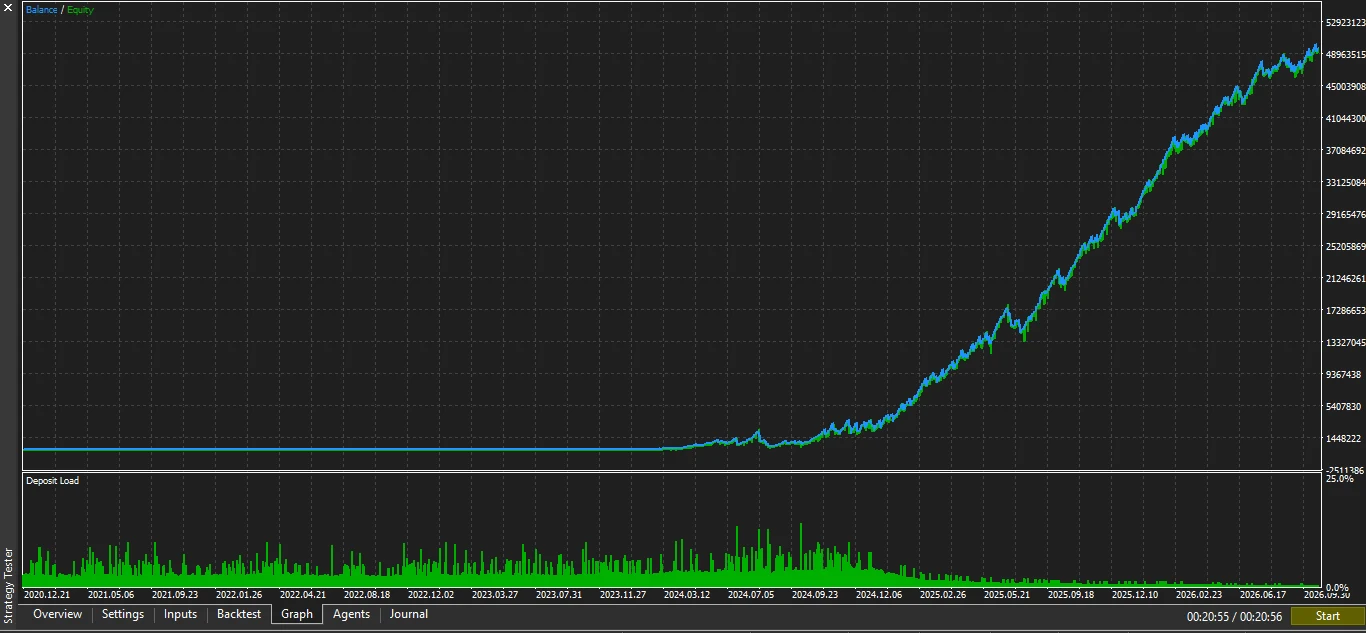
The set file you choose matters more than anything else here. The Aggressive set (Run 3) put about 26% of the balance at risk on each trade. It ran the account from $2,000 to $59,629 by November 2022, then lost 90.24% of that balance by 30 May 2023 and took 477 days to make a new high. The final $49.6 million figure only came from compounding up to 200 lots per trade, a size no real account should be assumed to fill cleanly.
The win rate is the next risk. Because each loss is larger than each win, a drop in the win rate quickly erases profit. That can happen in a new market regime, at a different broker, or after an update to the entry logic. The worst losing streak in Run 1 was only five trades, but the 2023 stall shows how long a weaker period can last.
Holding time adds costs and gap risk. Positions stayed open for 27 hours on average and up to 270 hours, so swap cost eight times more than commission. Wednesday’s triple swap is paid because that close option is off in the developer’s sets. Finally, history quality was only 4% to 7% real ticks, so the $16 trailing start and $0.50 steps were simulated mostly on generated prices. Live fills will differ.
How It Compares
Our earlier Ghost Scalper MT5 test report covered a gold EA with almost the opposite design. Ghost Scalper placed about 34 trades a week through pending breakout orders, at a fixed 0.01 lot. My AI Gold places about three market trades a week, sizes them from the balance and holds them for about a day. Ghost Scalper’s average win was larger than its average loss, whereas My AI Gold depends on winning about seven trades in ten.
Our own 15m Gold Scalper MT5 EA trades closed-bar EMA/RSI momentum signals on M15, with a swing stop and a partial-profit ladder. It is free, but its optional loss-recovery ladder adds the kind of exposure My AI Gold avoids. Other gold robots we have documented are listed under Expert Advisors.
Installing It and Testing It Yourself
Open the developer’s official page and click Free Demo; MetaTrader 5 installs the demo under Market in the Navigator. The demo runs only in the Strategy Tester. Press Ctrl+R, pick My AI Gold, choose XAUUSD on H1 and “Every tick based on real ticks”, then load one of the developer’s set files under Inputs. After each run, check the history-quality figure, because ours was only 4% to 7%.
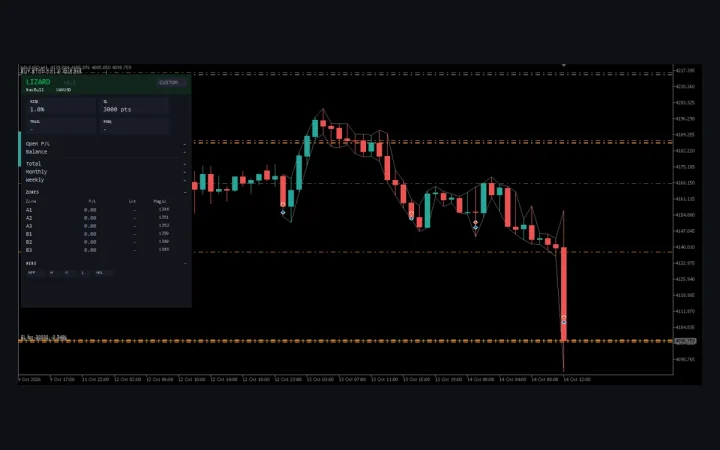
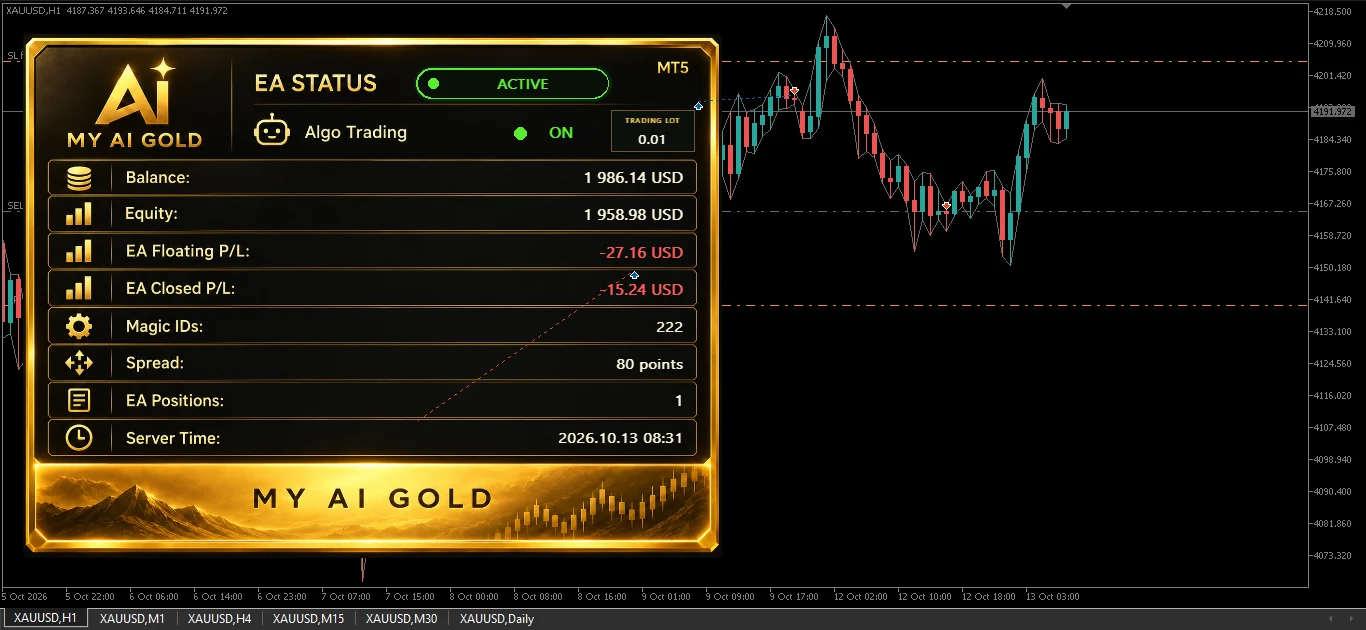
Then test what we did not. Run the Conservative set again with a wider spread, and on a second broker’s data if you have it, to check the “broker independent” claim. Read the next-lot figure on the panel before every live start, since that is where a wrong risk setting shows up. If you buy or rent, run the EA on a demo account for at least 90 days before risking live money.
Advantages and Disadvantages
Advantages
- Every entry had a stop-loss and take-profit, and no grid, averaging or martingale appeared.
- The Conservative set was profitable in every full year from 2021 to 2025, with an 11.37% maximum equity drawdown.
- The Prop set kept its worst closed day to −1.92% with one trade at a time.
- It trades rarely and holds for about a day, so spread and commission matter less than for scalpers.
- The panel shows the next lot size before a trade opens (v1.82).
Disadvantages
- The stop ($40) is wider than the target ($25), the reverse of the listing’s 1:2 claim.
- The Aggressive set risked about 26% per trade and fell 92.76% at one point.
- Only 4% to 7% real-tick history quality.
- Most of the test window predates the September 2026 re-optimization.
- Swap costs add up, and the Wednesday close option is off in the developer’s sets.
- The input names (riskk, RST, TKProfit) say little about what they control.
Source, Licence and Distribution
- Rights
- Commercial product
- Developer
- Vitalii Kosov
- Licence
- Commercial (MQL5 Market)
- Official price
- $799.95
- Version tested
- 1.82
- Tool type
- Expert Advisor
Commercial product. This report covers the trading logic and our own test results. Purchase, licensing, support and updates are handled by the developer via the official page. AlgoToolbox does not sell, host or sublicense this software.
How we tested it. We downloaded the free demo version from the developer’s official MQL5 Market page and ran it in the MetaTrader 5 Strategy Tester. Market demo versions only run in the Strategy Tester. The performance results from our own tests in this report are backtests, not live or forward trading. We did not buy a licence and did not receive a free copy or any payment from the developer. The developer did not see or approve this report before publication. We earn nothing if you buy this product. How we test and score.
Frequently Asked Questions
Does My AI Gold use martingale or a grid?
Not in our runs. Each entry was a single market order with its own stop-loss and take-profit, and there were never more than two open positions (one with the Prop set). Lot size grew with the balance and never stepped up right after a loss. The Recovery option, which holds the lot size after a loss, was off in all three of the developer’s sets we used.
What deposit does My AI Gold need?
The listing recommends $1,000 for normal risk and $2,000 for low risk. We used $2,000 for every run. On that deposit, the Conservative set risked about 1.8% per trade and the Prop set about 1.5%. The Aggressive set risked about 26% of the balance per trade, and it lost 90.24% of its peak balance between November 2022 and May 2023.
Is this My AI Gold MT5 review based on live trading?
No. The Market demo runs only in the MT5 Strategy Tester, so every figure we measured is a backtest. The two live accounts we mention belong to the developer; we only quote their published statistics as of 25 October 2026. Treat both kinds of evidence as limited: our backtests used mostly generated ticks, and the live accounts are only weeks old.
Is My AI Gold a scam?
Our test does not support that label. The EA did what most of the listing says: stop-loss and take-profit on every trade, no grid, H1 gold trading and profitable conservative backtests. One claim did not hold up: the 1:2 risk-to-reward ratio, which we measured as $40 risked for a $25 target. Judge the EA on that measured profile, not on the marketing.
Final Verdict
My AI Gold suits gold traders who will use the Conservative or Prop set, accept a high-win-rate system whose losses are larger than its wins, and judge results over months. It is not for anyone drawn to the Aggressive set or expecting the advertised 1:2 reward profile. The Conservative run was steady across six years, with stops on every trade. However, its edge rests on a 72% win rate that we tested on only one broker’s data, mostly with generated ticks.
Our conclusion from this My AI Gold MT5 review is short. Steady on conservative presets, but every stop is wider than its target, unlike the listing claims, and the aggressive preset fell 92%. Before paying, rerun the Conservative set with a wider spread, check the next-lot figure on the panel, and give it 90 days on a demo account.
We score it 3.5 out of 5. Results scored highest, while the risk-to-reward claim we could not reproduce and the Aggressive preset’s 92.76% drawdown pulled the claims and risk-control criteria down. The five-criteria breakdown is in the verdict card above.
⚠️ Risk & Transparency Notice: All indicators, scripts, and backtest results on AlgoToolbox are for educational and testing purposes only. Trading Forex, CFDs, and cryptocurrencies carries significant financial risk. Past performance does not guarantee future results. This article may contain contextual affiliate links to tools or brokers we use. Read our full Risk Disclaimer.