Lizard EA MT5 Review
Lizard v2.1 backtested on XAUUSD H1 with three stop presets: profitable in every run, but nearly every win came from a stop moved into profit within seconds.
This Lizard EA MT5 review tests Marco Scherer’s $99 gold Expert Advisor with its three stop-loss presets in the Strategy Tester. Lizard trades XAUUSD from the H1 chart with six breakout strategies that place stop orders beyond recent swing highs and lows. Every order goes to the broker with a stop-loss, and position size follows a fixed percentage of the balance.
We ran version 2.1 from the Market demo on a raw-spread account from December 2020 to 27 October 2026. All three runs made money, and the High preset ended with a 2.27 profit factor and a 12.28% maximum equity drawdown. However, half of all trades lasted under a minute, and nearly every winner was closed by a stop already pulled into profit.
Test Bench
| Specification | Our configuration |
|---|---|
| Platform | MetaTrader 5 |
| Tool type | Expert Advisor |
| Version tested | 2.1 |
| Symbol / timeframe | XAUUSD H1 |
| Test period | 2020.12.03 – 2026.10.27 |
| Data / tick mode | Every tick based on real ticks (history quality 70% real ticks; Run 1: 15%) |
| Account & spread | Exness Raw Spread (MT5Real7), variable spread, $0.04 commission per 0.01 lot, $1,000 deposit (Run 1: $250), 1:100 |
| Copy tested | Free demo (MQL5 Market), Strategy Tester |
What Lizard Is and What the Listing Promises
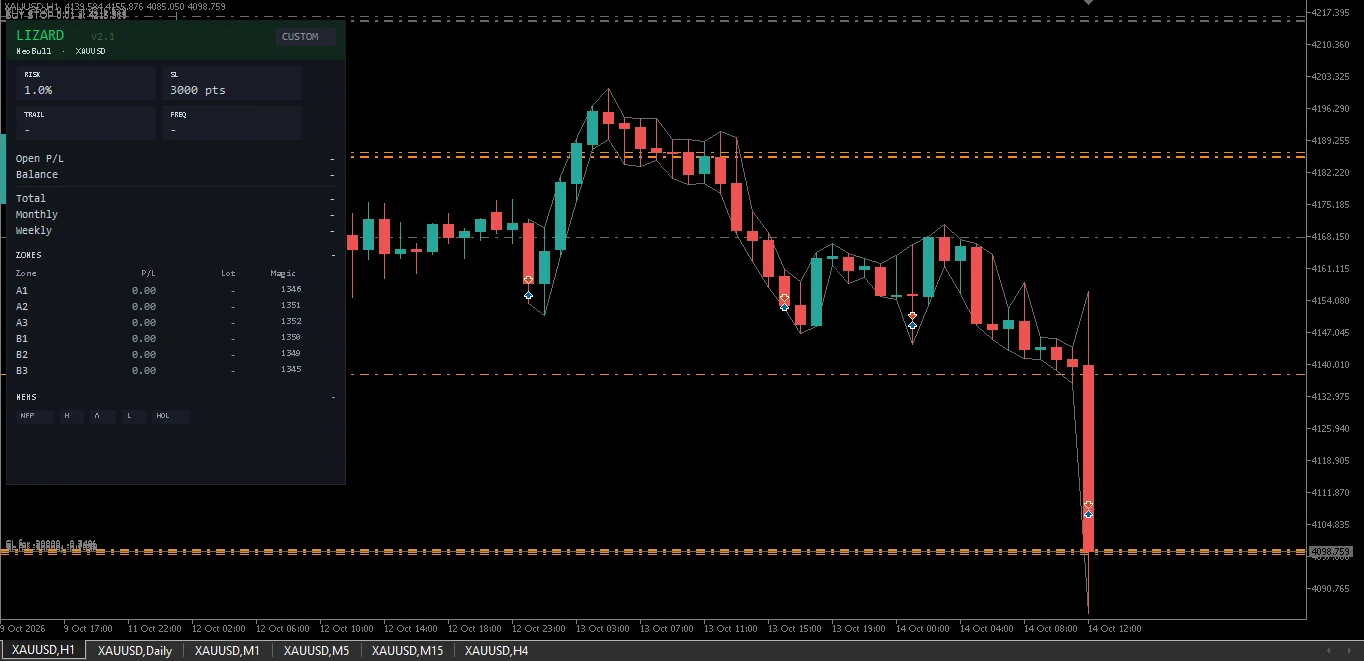
Lizard is a fully automated Expert Advisor for gold. The official MQL5 Market listing describes a multi-strategy swing breakout system. The EA finds swing highs and lows on the H1 chart and places pending stop orders beyond them, so a trade opens only when price actually breaks out. Six strategies, or zones, run at the same time, each with its own stop-loss, trailing logic, magic number and risk weighting.
The listing makes several specific claims. It says there is no martingale, no grid and no averaging into losses, and that every trade opens with a defined stop-loss and take-profit. It describes a multi-layer exit system with break-even, trailing stop and trailing take-profit, a virtual stop-loss handled in software, an hour filter, a news filter for US payrolls and a maximum-daily-loss input for prop firms. It also says that up to $1,000 only zone A trades, and that zones A and B both trade from $1,001.
The requirements are XAUUSD on H1, a $250 minimum balance, a hedging account (ECN or raw spread recommended), leverage of 1:100 or more and a VPS. On 27 October 2026 the price was $99. The EA was published on 9 May 2026, and its version history lists about 30 releases since then. We tested version 2.1 (4 October 2026), the current release, which added a newer hour-filter profile.
How It Trades in the Tester
This section describes what the deal and order lists record, not the code, which we cannot see. The three runs used the same settings except for the stop-loss distance. The High run (Run 2) opened 7,605 positions from December 2020 to October 2026, about 25 a week. The H1 chart sets where the orders sit, but the trades themselves last seconds or minutes.
Entry
Every one of the 7,605 entries came from a buy-stop or sell-stop order; the EA never opened a position at market. Orders sit a fixed distance from recent swing levels and are canceled when the setup expires. Entries peak between 12:00 and 14:00 server time and almost stop after 20:00, consistent with the hour filter and the 120-minute close window before the broker’s daily break.
Exit
Each entry order carried a hard stop $30, $10 or $5 from entry, depending on the preset, and none carried a take-profit. The default Dynamic High trailing mode then took over: in the High run, 5,592 of the 5,634 stop exits closed with the stop already at or beyond the entry price. In other words, the stop was pulled into profit, often within seconds. Another 1,883 trades closed without an exit label after a median of exactly eight minutes, matching the default fakeout timer, which closes positions still in loss.
Position management
We saw no grid, no averaging and no martingale. Lot size follows 1% of the balance per position: the High run started at 0.01 lots on $1,000 and reached 0.17 lots. The six zones trade independently, though, so several can open at the same second. Up to nine positions were open at once, and 1,089 positions opened at exactly the same time and price as another zone’s position, in stacks of up to five.
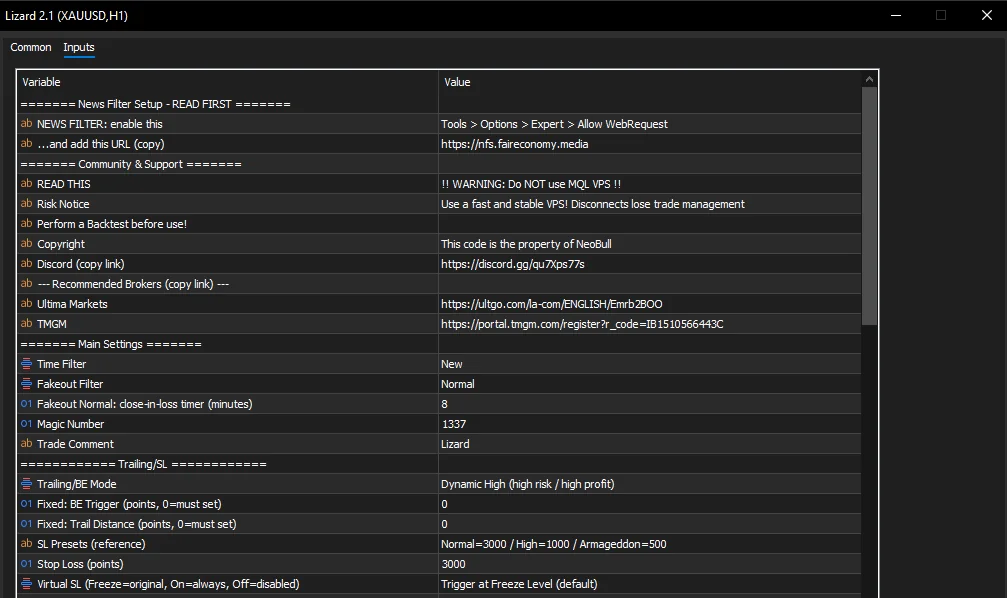
Our Test Setup
| Input | Default | Our value | Why |
|---|---|---|---|
| Stop Loss (points) | 3000 (Normal) | 3000 · 1000 · 500 | The three presets in the EA’s own note; measured as $30, $10 and $5 from entry |
| Risk % | 1.0 | Unchanged | Sizes each position; the inputs call it “not a loss cap” |
| Trailing/BE mode | Dynamic High | Unchanged | Moves the stop into profit; behind most exits |
| Virtual SL | Trigger at Freeze Level | Unchanged | An internal stop takes over if the broker blocks a stop change |
| Time Filter / Fakeout | New / Normal, 8 min | Unchanged | The 2.1 hour profile and the eight-minute loss timer |
| Zones A1 to B3 | All on | Unchanged | All six breakout strategies active from the first trade |
| Max Daily DD | 0 (off) | Unchanged | The prop-firm loss limit was not tested |
| News filters | On | Unchanged | The online news feed cannot load in the Strategy Tester |
Disclosure: the broker link below is an affiliate link; AlgoToolbox may earn a commission at no cost to you. It does not affect our test results.
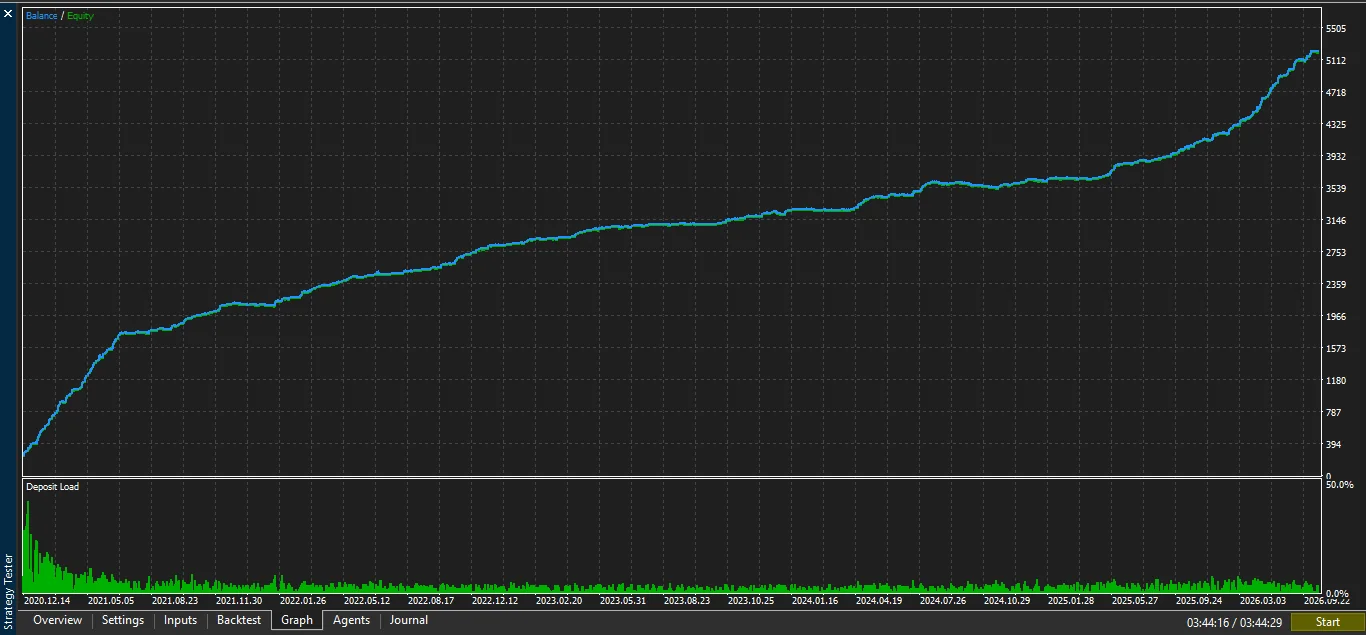
Run 1 used the default inputs, which are the Normal preset, on the developer’s $250 minimum deposit. Runs 2 and 3 changed only the stop to the High and Armageddon presets, on $1,000. All three ran on the Exness-MT5Real7 server (terminal build 6230) on an Exness raw-spread account, with 1:100 leverage, XAUUSD H1, “Every tick based on real ticks” and a commission of $0.04 per 0.01 lot.
We set the start date to 1 January 2020, but the server’s gold history begins in early December 2020, so the first trade came on 3 December 2020. History quality was 70% real ticks in Runs 2 and 3 but only 15% in Run 1; the rest were generated ticks. That gap matters for an EA that trades in seconds. Our bench rules are on the how we test page.
Backtest Results: Reading the Data
We treat the High run (Run 2) as the reference, because it has the better tick data and a realistic deposit. It grew $1,000 to $17,469.06. The curve has three phases: fast growth in 2021 (+248%), a long plateau from 2022 to mid-2025, and a steep climb from late 2025 that made 2026 the best year at +154.9%. Lot size grows with the balance, so the last phase is partly compounding.
The plateau is the part to study. Profit fell to +3.8% in 2023, and 2024 lost 1.5%. The balance went 402 days without a new high, from 22 August 2024 to 29 September 2025, and the largest balance drawdown, 11.99% ($670.07), came inside that stretch. In all, 22 of 71 months lost money, and the worst closed day lost 2.26% of the balance.
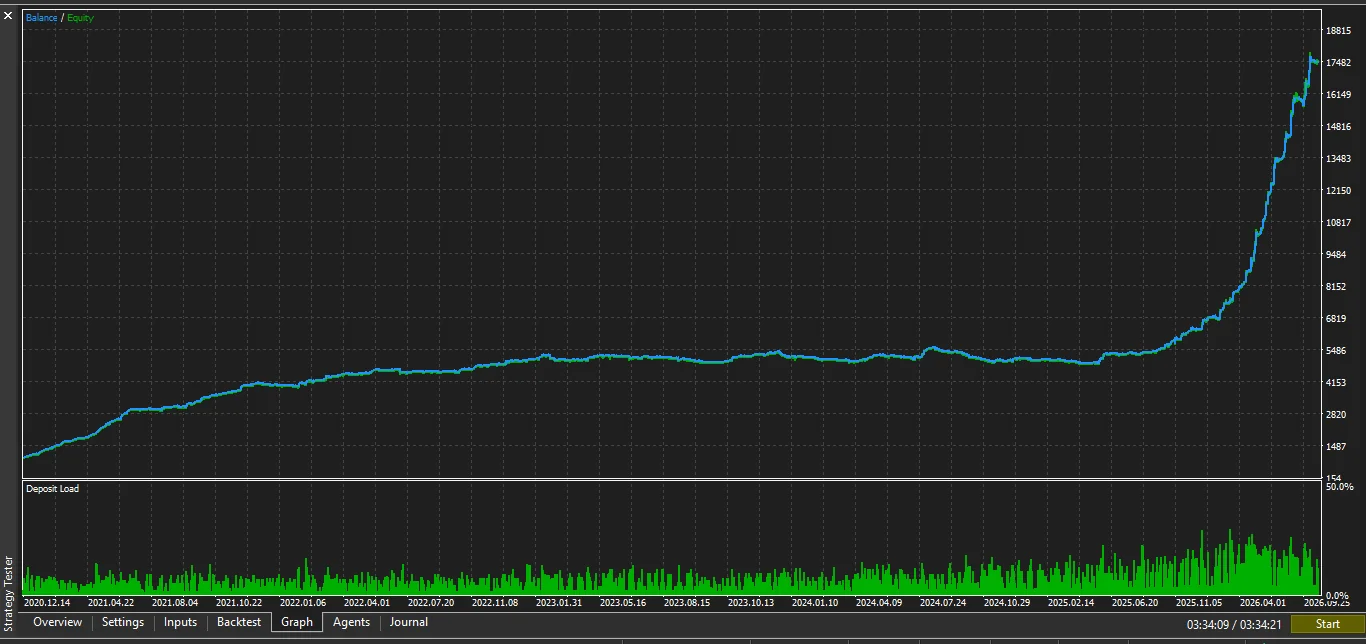
| Metric | Result | Source | What It Tells You |
|---|---|---|---|
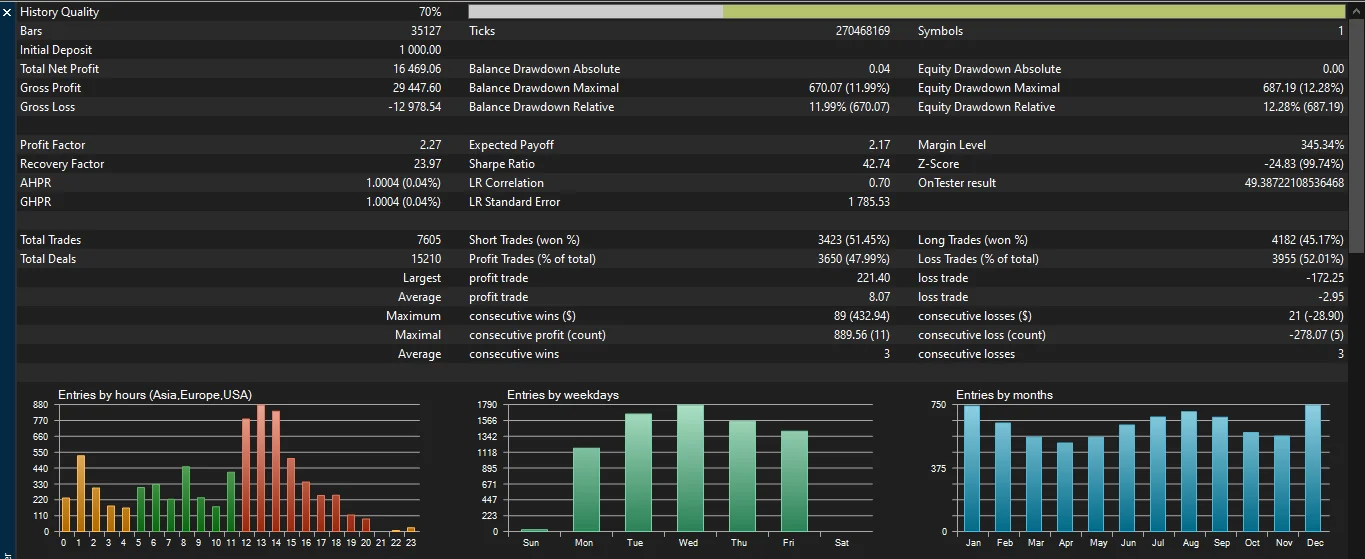
| Total net profit | $16,469.06 on $1,000 | Run 2 report (Figure 4) | Compounded at 1% risk per position |
| Profit factor | 2.27 | Run 2 report (Figure 4) | Gross profit $29,447.60 against gross loss $12,978.54 |
| Trades and win rate | 7,605 trades, 47.99% won | Run 2 report (Figure 4) | Average win $8.07 vs average loss $2.95: small, quick losses |
| Max equity drawdown | 12.28% ($687.19) | Run 2 report (Figure 4) | The deepest equity dip of the run; the largest balance drop came in 2024–2025 |
| Holding time | Median 52 seconds | Run 2 deal list | 56% of trades closed within a minute, 25% within ten seconds |
| Trading costs | $1,321.10 commission, no swap | Run 2 deal list | Positions are closed before the daily break |
| Normal preset (defaults) | $4,960.17 on $250, PF 3.07, 2.60% max equity DD | Run 1 report (Figure 5) | Only 15% real ticks; fixed at 0.01 lot all the way |
| Armageddon preset | $482,884.28, PF 2.54, 26.05% max balance DD | Run 3 report | Compounding to 9.9 lots per position; not a realistic projection |
Robustness Checks
Compounding hides how the edge changed over time, so we rescaled every trade to a fixed 0.01 lot and subtracted $0.04 commission. This is arithmetic on the reports, not a new test. On that basis, the High run made $1,493 from December 2020 to June 2021, only $962 from July 2021 to December 2025 and $997 in 2026. The long middle window earned about $0.15 per trade before any live slippage, a thin margin.
Run 1 (Normal, defaults) cannot serve as a clean second check. It took exactly the same entries as Run 2 in early 2021 and in 2026, but only 16.5% of its middle-window entries matched. With only 15% real ticks, much of that window was probably simulated, and its better middle-window result ($0.40 per trade) should not be relied on. This is an inference from the data-quality figures, not a measured fact.
The whole window is in-sample. The listing says the hour filter blocks hours that showed a profit factor below 1.0 “in the historical evaluation”, and version 2.1 introduced a new profile “based on fresh data analysis”. Since 2.1 was released on 4 October 2026, the High run has 62 trades: +$475.68, profit factor 2.95. That is too few to judge. We did not run a second broker, a wider spread or another period.
Listing Claims vs Our Results
| Claim (listing) | What we measured | Match? |
|---|---|---|
| No martingale, no grid, no averaging | Lot follows 1% of the balance; no positions added after losses | ✅ matches |
| Breakout entries with buy-stop and sell-stop orders | All 7,605 entries came from pending stop orders | ✅ matches |
| Every trade opens with a defined stop-loss and take-profit | Every entry order had a broker-side stop; none had a take-profit | ⚠️ partly |
| Multi-layer exits: break-even, trailing stop and target | 5,592 of 5,634 stop exits closed with the stop at or beyond entry; 88 “tp” exits | ✅ matches |
| Six independent strategies | Six magic numbers, but zone B1 took 55% of trades; 1,089 positions shared an exact entry with another zone | ⚠️ partly |
| Up to $1,000 only zone A; A and B from $1,001 | Default inputs switch all six zones on; Run 1’s first trade, at $250, came from zone B1 | ❌ not reproduced |
| Prop firm ready: maximum daily loss input | Input present, off by default; not tested switched on | — not tested |
| News filter pauses trading around US payrolls | The feed loads through a web request, which the tester does not run | — not testable in a demo |
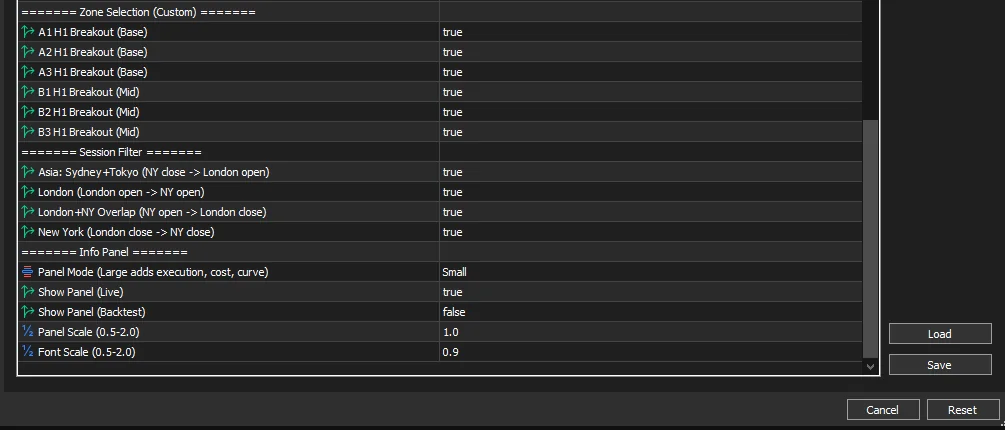
The zone claim is the clearest mismatch. In the default inputs, all six zones sit under a “Zone Selection (Custom)” heading, each set to true, and the $250 Normal run opened its very first trade in zone B1. The listing’s balance rule may apply in another mode, but it did not apply to the defaults we loaded. The version history adds to the confusion: release 1.75 said all zones are active from $500, and release 1.30 described tiers at $0, $1,000 and $2,000.
The take-profit claim needs a narrower reading. No order carried a take-profit price, and wins came from the trailing stop or from code-managed closes labeled “tp”. The virtual stop is a second, internal stop: the version history says it runs alongside the hard stop because “on some brokers the freeze level caused odd trades”. In the tester, every position also kept its broker-side stop.
Risk Profile and When It Fails
The main risk is execution. Most profit came from stops moved into profit within seconds and filled close to their level: in the High run, stop exits filled on average $0.04 worse than the stop price. Live trading adds latency, requotes and broker limits on how close a stop may sit, which the version history repeatedly addresses. The EA’s own inputs warn “Do NOT use MQL VPS” and say that disconnects lose trade management.
Stacked entries are the second risk. Risk is set at 1% per position, not per signal. On 4 May 2026 five zones sold within the same second; three entered at the identical price and stopped out together 63 seconds later. In the High run, that cluster lost $279.67, about 3% of the balance. At the $250 minimum, a $30 stop on the smallest 0.01 lot already risks 12% per position, although Run 1’s largest actual loss was $14.10.
Compounding is the third. The Armageddon preset ($5 stop) reached 9.9 lots per position and showed a 26.05% balance drawdown between August 2024 and April 2025; its $482,884 total assumes fills at sizes the test cannot vouch for. Finally, the edge thinned for years at a time. From 2023 to mid-2025 the High run was almost flat, so a buyer could wait more than a year for a new high.
How It Compares
Our Ghost Scalper MT5 test report covered a gold EA with a similar idea: H1 breakout levels, pending orders and trailing stops, at about 34 trades a week on a fixed 0.01 lot. Lizard trades less often, about 25 times a week, but holds for far shorter: about four minutes on average, against 27 minutes in that test. Both depend on how a broker fills stops, so neither backtest says much about live slippage.
The My AI Gold MT5 test report shows the opposite design. That EA places about three market orders a week, holds them for about a day, and wins about seven trades in ten with stops wider than targets. Lizard wins fewer than half its trades but keeps losses small. All our third-party results are collected under test reports.
Installing It and Testing It Yourself
Open the developer’s official page and click Free Demo; MetaTrader 5 installs the demo under Market in the Navigator. The demo runs only in the Strategy Tester. Press Ctrl+R, pick Lizard, choose XAUUSD on H1 and “Every tick based on real ticks”, and use a hedging account. Before reading any result, check the history-quality figure: one of our runs reached only 15%, and that alone changed thousands of trades.
Then test what we did not. Run the High preset on a second broker’s data, and switch on the Max Daily DD input if you plan a prop-firm challenge. Watch a few trades in visual mode to see how fast the stop moves. If you buy, run the EA on a demo account with a low-latency VPS for at least 90 days, and compare its fills with the tester before risking live money.
Advantages and Disadvantages
Advantages
- Every order reaches the broker with a hard stop-loss; no grid or martingale.
- Profitable in all three presets, with a 12.28% maximum equity drawdown on High.
- Small losses: the High run’s average loss was $2.95 against an average win of $8.07.
- No swap costs in our runs: positions close before the daily break.
- Low price ($99) and frequent updates.
Disadvantages
- Most profit comes from stops moved into profit within seconds, which depends on fast execution.
- Thin edge from mid-2021 to 2025: about $0.15 per 0.01-lot trade.
- Zones stack: up to five entries at one price, so 1% risk can become 3% or more.
- Default inputs ignore the listing’s balance-based zone rule.
- No take-profit is ever sent to the broker.
- The hour filter was chosen on the same history; needs a VPS other than the MQL5 one.
Source, Licence and Distribution
- Rights
- Commercial product
- Developer
- Marco Scherer
- Licence
- Commercial (MQL5 Market)
- Official price
- $99
- Version tested
- 2.1
- Tool type
- Expert Advisor
Commercial product. This report covers the trading logic and our own test results. Purchase, licensing, support and updates are handled by the developer via the official page. AlgoToolbox does not sell, host or sublicense this software.
How we tested it. We downloaded the free demo version from the developer’s official MQL5 Market page and ran it in the MetaTrader 5 Strategy Tester. Market demo versions only run in the Strategy Tester. The performance results from our own tests in this report are backtests, not live or forward trading. We did not buy a licence and did not receive a free copy or any payment from the developer. The developer did not see or approve this report before publication. We earn nothing if you buy this product. How we test and score.
Frequently Asked Questions
Does Lizard use martingale or a grid?
Not in our runs. Each position came from a single pending stop order with its own hard stop, and lot size followed 1% of the balance without stepping up after losses. Several zones can, however, open at the same moment and price, up to five at once in our runs. That is not averaging, but it does multiply the risk of one signal.
What deposit does Lizard need?
The listing’s minimum is $250. On that balance the EA trades the smallest 0.01 lot, so the default $30 stop risks 12% per position, well above the 1% setting. Our $250 run stayed at 0.01 lot for six years and its largest loss was $14.10. A $1,000 deposit lets the 1% sizing work as intended on the High preset.
Is this Lizard EA MT5 review based on live trading?
No. The Market demo runs only in the MT5 Strategy Tester, so every figure here is a backtest. The tester fills stops without the delays of a live connection. Because Lizard’s profit depends on stops that move within seconds, live results could differ more than usual, in either direction. A demo account with a fast VPS is the next step.
Is Lizard a scam?
Our test does not support that label. The EA did what most of the listing says: pending breakout entries, hard stops on every order, no grid and profitable backtests in all three presets. Two claims did not hold as written: the balance-based zone rule in the default inputs and the attached take-profit. Judge it on the measured behavior.
Final Verdict
Lizard suits gold traders who have a fast, stable VPS, will start with the Normal or High preset and can accept long flat periods. It is not for anyone on a slow connection or the MQL5 VPS, or anyone relying on the listing’s balance-based zone limits. The backtests are clean in structure, with hard stops and no recovery tricks. However, nearly all the profit rests on stops that move within seconds, and the tester is the friendliest possible place for that.
Our conclusion from this Lizard EA MT5 review is short. Profitable in all three runs, but almost every win is a stop pulled into profit within seconds, which live execution may not repeat. Before paying, rerun the High preset on another broker’s data, check your history quality, and give it 90 days on a demo account with the VPS you plan to use.
We score it 3.0 out of 5. Results scored highest; robustness pulled the score down, because the edge was thin for years, the hour filter was fitted on the same history and the profit depends on fast stop management. The five-criteria breakdown is in the verdict card above.
⚠️ Risk & Transparency Notice: All indicators, scripts, and backtest results on AlgoToolbox are for educational and testing purposes only. Trading Forex, CFDs, and cryptocurrencies carries significant financial risk. Past performance does not guarantee future results. This article may contain contextual affiliate links to tools or brokers we use. Read our full Risk Disclaimer.